AI-generated content may seem polished and professional but it isn’t. The writing may have proper grammar but is not misleading, generic, incomplete, or off-brand. That makes it possible for reviewers to overlook problems during the cursory glance.
Furthermore, AI has no knowledge of your business like your employees. Generates language patterns from training data and prompts.
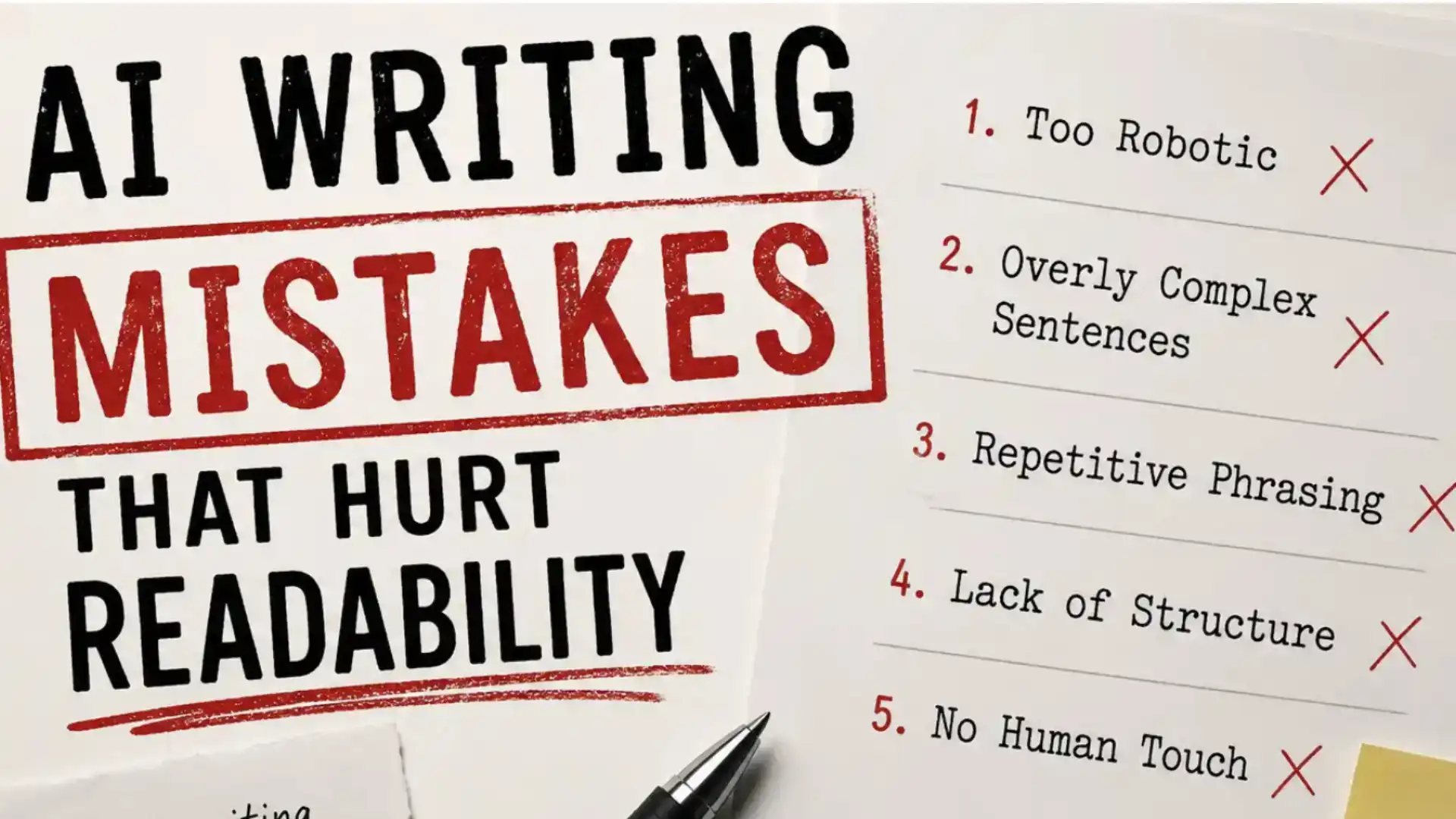
It is not really a true testament to all of the claims, to the interpretation of all policies, and to all of the needs of the audience. The following blog will discuss all the mistakes that hurt readability.
Mistakes to Avoid While Using AI for Writing
Mistake 1: Confident but incorrect information
One of the common mistakes with AI content is the misinformation that comes across with assurance. AI might miss a part of a date, misinterpret a process, a requirement, a product detail and present it in a tone that is totally firm. That poses clear threats to business content.
This is particularly hazardous when it applies to training, help, healthcare content and regulated industries. A reader may take the statement for granted that it is accurate given its polished sound. Unfortunately, words can be heavy where there isn’t much substance.
To correct this issue, check all significant statements with an approved source. This means internal source files, process guides, product information, legal language and policy references. A statement should not be accepted as correct solely because of its professional soundness.
When evaluating factual claims, use this AI content checklist for teams:
- Verify dates, names, version numbers and product information with the source material.
- Compare all process steps with internal approved materials.
- Indicate statements that are not supported and from which there is no clear source.
- Eliminate invented examples unless marked with examples.
Mistake 2: Writing that is Generic, like Everyone Else
Another AI content pitfall is using general phrases. Because AI tends to default to safe and broad language, it might be applicable to nearly any company. This can make your content seem flat, boring and easily ignored.
Content that is written in a generic way makes web pages, sales literature, employer branding and thought leadership less effective. It can ruin SEO as well because a search engine values content that is original and useful and has clear value. The need for people-first content that offers real value is highlighted with Google’s guidance on helpful content. Read Google’s useful content guidelines.
To solve this problem, make sure to include the details that AI lacks. There should be examples, audience information, real business context and some meaningful differentiation. Avoid using general terms; use specific terms that are more likely to be associated with your company, process, or service model.
For instance, when you say that your team provides “high-quality solutions,” you should describe what they actually do, who they are helping and how they are helping.
Without intervention, these typical AI content pitfalls can subtly erode trust even when no one suspects.
Mistake 3: Off-Brand Tone and Voice
While AI can replicate a tone, it may not accurately capture the nuances of brand voice. Consequently, the content may seem too academic, too conversational, too promotional, or plain and simple, it may not be your normal content. This is one of the typical AI content errors that buyers realize early on.
When two or more teams utilize AI with different rules, it becomes more apparent. One page can be clear and consize, the other can be ambiguous or robotic. This is a situation that may compromise the trust within your site or content library.
To fix tone and voice issues, compare AI output to approved content samples. Reviewers should highlight sentence style, word choice, pacing and brand personality. It also keeps a concise voice guide, including any preferred wording, what to avoid, and what the audience is expecting.
Take this time to review these points:
- Is the text sound like your business or is it like any other AI-generated content?
- Is the tone appropriate for audience, purpose and channel?
- Do you have phrases you will never use in published content?
- Is the page’s tone similar to the surrounding pages within the site?
Mistake 4: Lack of Context and Missing Steps
AI can often be too aggressive at compressing information. It might miss out essential information for setup, delete required warnings, or leave out steps that are intuitively understood by an expert. Then readers are given partial instructions, flaky explanations or material that leaves them more confused than enlightened.
This problem is commonly encountered in training material, software documentation, help documentation and internal process documents. A draft may be efficient but it doesn’t really support the user. This, in reality, translates to a greater number of support questions, rework, and user frustration.
To correct this problem, read the content as if you were the reader. What would a new employee, customer or end user need to be successful? Then check to see if that information is there in the right order.
The following gaps should be considered when reviewing:
- Not providing the required prerequisites or setup information.
- Failure to acknowledge the warnings, cautions, or limitations.
- A sequence of steps that are omitted from a process.
- Words or phrases that the new reader might not recognize.
Mistake 5: Repetition and Poor Structure
Various AI drafts restate the same point a few times with different languages. They might also use weak transitions, some general headings or filler phrases. That will make the content seem longer, but not more useful.
One of the most frequent AI content errors is repetition, which happens when AI extends patterns to generate content. For a general prompt, the draft may wander around a topic rather than developing a line of thought or an argument.
For this issue, make structural edits first, then line-level polishing. Refine headings; eliminate redundant information; merge duplicate paragraphs. Include a purpose and advance in each section.
A thorough structure review should determine the answers to the following:
- Do all the headings present different ideas?
- Is there any new value added in each paragraph?
- Is there a flow to the page with the aid of transitions?
- Are there any ideas that can be combined or eliminated?
Final Words – AI Writing Mistakes
There are easy-to-make mistakes and easy-to-forget mistakes with AI-generated content.There are common mistakes and even more common mistakes people make with AI-generated content. Hence, organizations need more than just speed. They must be reviewed, validated and edited before content reaches real audiences.
There is a positive side to all that: these issues can be addressed. Practical review process will help teams to identify errors, enhance your clarity, boost your brand voice, and minimize the publishing risk.
Content review and validation services are beneficial for organizations creating content on a large scale with AI tools, as they help ensure the content is reviewed by humans to prevent errors from reaching your audience.
FAQs – AI Writing Mistakes
Q1. How to detect AI-written articles?
While sometimes it’s evident, AI-generated content can sometimes seem clichéd, overly polished, or generic. If the article is using the same phrases over and over, contains little to no personal examples, or has a lot to say, but doesn’t offer much insight, the article may have been produced by AI.
Q2. Is AI responsible for making content less credible?
Not necessarily. The tool to create the information is less important than the quality of the information. But, AI technology can sometimes produce information that’s wrong or out of date, which is why fact-checking is crucial.
Q3. What amount of editing is required for AI created content?
As much as necessary so that it sounds natural and useful. There are minor changes in some and major rebuild in others. A general guideline is to edit every paragraph as a “junior writer” and edit it before printing.
Q4. What is the reason why AI articles repeat the same words over and over?
AI models are trained on patterns in millions of documents on the internet. Since some words are used many times in the training set, the model might be more likely to use them than a human writer.
Q5. Can AI help me become a better writer?
Yes, if the user uses it properly. AI can be used to brainstorm ideas, craft outlines, break through writer’s block, and enhance productivity. It can be helpful to use it to a certain extent, but don’t use it so much that you do not have the chance to find your own way of writing.
Read More : Best Ways to Rewrite AI Content Naturally