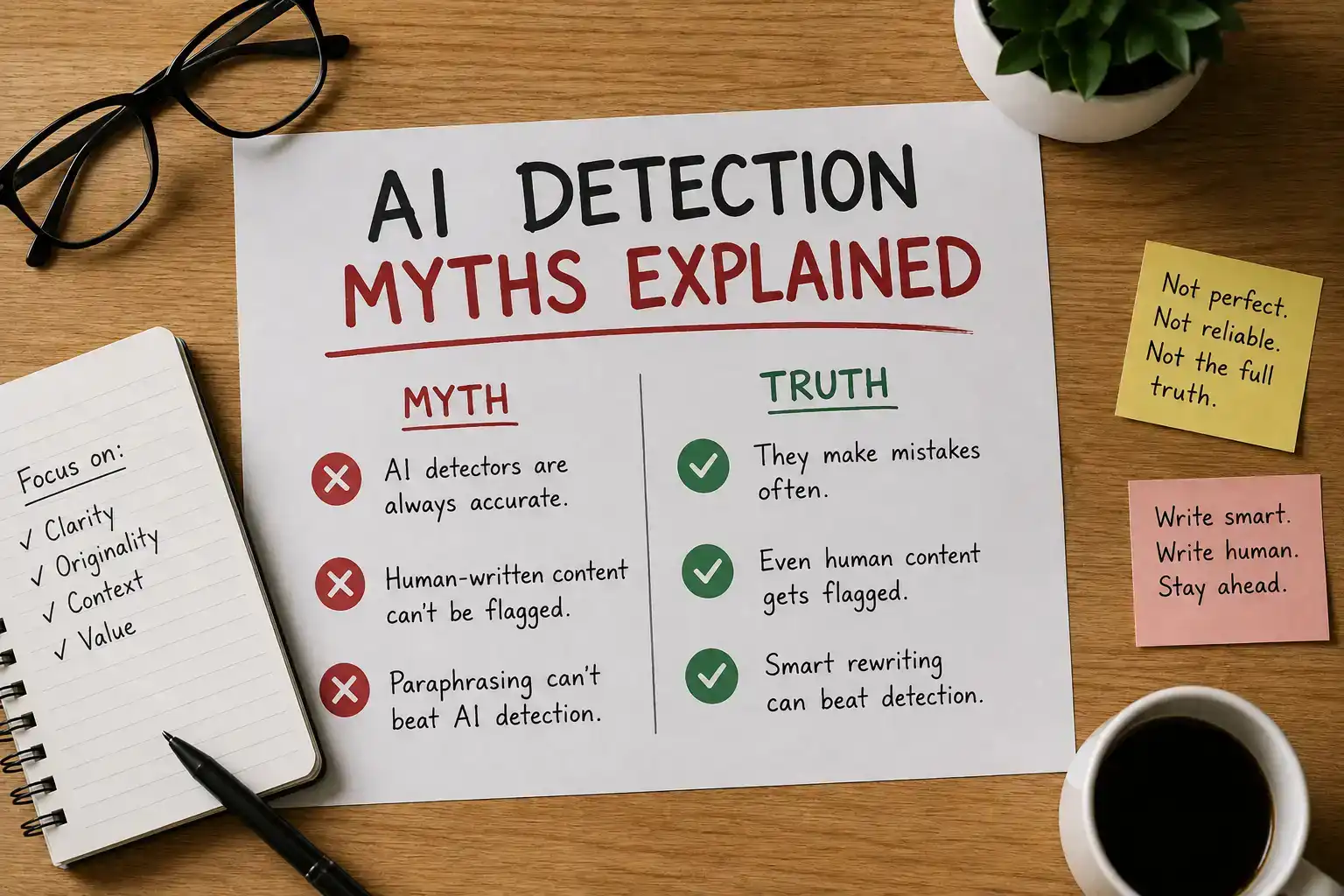
With the rise of generative AI, AI detection tools have become increasingly popular. So have many misconceptions about AI detection which lead to undue fear for writers, marketers, and editors. There are many people who think these kinds of tools are foolproof or can “grade” an essay like a teacher does. Most detectors are pattern-matching algorithms that have been trained on a particular set of data, and they get wrong answers just as often.
This blog will discuss 10 common misconceptions to allow you to take a sceptical look at content detectors—and stay focused on the content you’re writing for your audience, not a scoring system.
10 Common AI Detection Myths
As AI detection tools become more popular, myths about their accuracy and capabilities continue to spread. Here are 10 common AI detection myths and the truth behind each one.
Myth 1: AI Detectors are Completely Accurate
AI Detectors are Completely Accurate. This is one of the largest of the common AI content detection myths to ignore. There is no absolute evidence of authorship. There are tools like GPTZero, Originality.ai, and Turnitin that can measure the probability of a text being AI-generated, in percentages. However, that’s a statistical guess, not a judgment.
There are a lot of false positives! Stanford researchers discovered in a study that AI detection tools often flag non-native English prose as AI content. There are no reliable machines for determining whether the content is likely machine or person-generated.
Myth 2: Detectors can also “Think” Like a Human Reviewer
One might imagine that detectors are looking for nuances, creativity, or originality. They don’t. The majority of the detectors compare statistical features like perplexity (the predictability of the text) and burstiness (the difference in sentence length and structure). AI-generated text tends to be less complex and have more consistent sentence length, while many humans can write predictable, even prose, particularly in the description of a procedure or instructions.
The tool is not a “reading device.” It compares the output patterns generated by a large language model with mathematical formulas, and identifies texts that match the patterns.
Myth 3: Every AI Detector is the same degree of accuracy
Tools have a wide range of accuracy. Others have been trained on the data of the older GPT-2 or GPT-3 models and do not work well with the newer GPT-4 or GPT-4o models. Others choose to be more precise but recall less, which means that they miss out on detecting AI-generated content but are more likely to identify content written by a human.
A 2024 study conducted by University of Maryland demonstrated that even the top detectors were still making between a 10% and 30% misclassification rate with human-written content. Using just one tool is a formula for false accusations.
Myth 4: If you write it yourself, the Detector will always say the text is “Human”
There is a particular moment in the life of many writers that gets them jolted out of their writing comfort zone: they submit their own original content to a detector and are told that the writing was generated by AI. This is because of false positives, particularly if the writing is clear and concise or is structured in a predictable way. Some tools are even flagging the US Constitution as AI-generated.
Origin cannot be determined by the style of writing. Your voice might sound like the statistics that are expected by them.
Myth 5: All detectors can successfully detect any type of AI-generated text, regardless of the AI model used
Typically, one or more AI models are trained to be used with detectors. A tool that has been optimized for GPT-3.5 will likely not understand Claude and Gemini’s text, or even GPT-4’s. However, new models emerge with new statistical characteristics and the game of detection is a never ending competition.
That’s why tools continuously update their algorithms—and that’s why they don’t always match the newest iteration of AI writing.
Myth 6: Switching between synonyms or rewriting sentences will trick all of the detectors
Often, surface-level rewrites would reduce a detection score, but it is not a sure-fire avoidance. Deeper structural patterns like topic transitions, paragraph progression and lexical diversity are analyzed by more sophisticated detectors. Switching a few synonyms can leave behind statistical “fingerprints” in the data.
However, well-structured rewriting with examples and ideas of your own typically yields content that detectors are able to score, and for good reason: it’s really human.
Myth 7: Low Detection scores always indicate that the content is not subject to penalties
But search engines such as Google have said it does not take the AI detection scores into account for ranking. The message is not about whether a sentence was written by a human or an AI, but about the helpfulness, reliability and expertise. A low detection score does not necessarily result in high rankings. In the same way a high detection rating will not necessarily affect your site if it contains valuable and original content. See How Google Responds to AI-Generated Content in 2026 for a similar guide.
The most effective way to do this is to create content that aligns with the intent of the searcher, regardless of the source or origin.
Myth 8: AI Detectors Only Target AI-Generated Texts is false
As a matter of fact, there are detectable biases in detectors. They often mark down English language learners and/or writers who are neurodivergent and write in a style that isn’t the norm for humans. This is an equity issue: Technologies that purport to preserve authenticity may actually marginalize authentic human expression.
Ethicists and researchers have long suggested the false-positive rates of the groups should be made more transparent, but few vendors are doing so.
Myth 9: Always use an AI Content Detector before publishing is a thing of the past
It is not a best practice to run all of the pieces through a detector. It can cause undue confusion, foster micro-managing prose strategy, and lower your own voice as you attempt to please a biased algorithm. Rather, spend the time checking facts and being clear and conveying what people need to know.
Be aware of internal policies at school/work, do not use a detection tool as a universal salvation tool for what “should” be happening, rather check specific guidelines.
Myth 10: AI Detectors Will Be 100% Accurate
This is likely the most hazardous myth. As the AI language models develop they are creating more and more human-like texts. No detector can ever be 100% accurate without false positives, due to the fact that the distributions for humans and AI will always overlap. The more humans copy AI patterns (in an attempt to pass detection) and the more AI models copy human variation, the more the line gets muddied.
It’s a dream come true to be able to detect any kind of issue in the future. A more attainable objective is to enhance the policy, disclosure, and ethical application of AI.
The myths about AI content detection are prevalent.There are numerous fake news regarding AI content detection.
Final Words – AI Detection Myths
Despite its impressive-sounding capabilities, there are still many misconceptions about AI content detection. Detectors are not truth machines but they are one of many signals. Here are some things to remember:
There is no detector that will be able to determine that any text was written by AI or a human.
There are hundreds of different human writers with false positives, especially clear writers and non-native speakers. Value and relevancy are the priorities of search engines, not detection scores.
The best form of quality assurance is an informed human review.
FAQs
Q1. Can AI content detectors be 100% accurate?
No. The statistical distributions of human and AI text overlap, so no detector will be 100% accurate. There are inherent limitations in technology that result in false positive/false negative.
Q2.Are search engines against AI content?
Google and other leading search engine giants have confirmed that they do not consider AI detection scores as ranking factors. They pay attention to the quality of content, originality, and helpfulness. If you’re interested in a similar guide check out How AI SEO Audits Identify Ranking Issues Faster.
Q3. What is a false positive in AI Detection?
A false-positive is when a detector identifies human-written text as being generated by AI. This is a common occurrence in clear, predictable or technical writing.
Q4. Is there a difference between the superior and inferior AI detectors?
Yes. A different tool, training data, and AI model will result in different accuracy. There’s no detector that performs better in all situations.
Q5. Why has my own writing been marked as AI?
Your text may resemble typical AI-related statistical patterns, such as having a similar number of sentence lengths or low lexical diversity. This is not to imply that your writing is going to sound like a robot, but that the model behind this tool is flawed.
Read More : From Robotic to Relatable: 7 Ways to Make AI Writing Sound Human
Read More : A Client Came to Us After AI Destroyed Their Affiliate Traffic — Here’s How We Fixed It