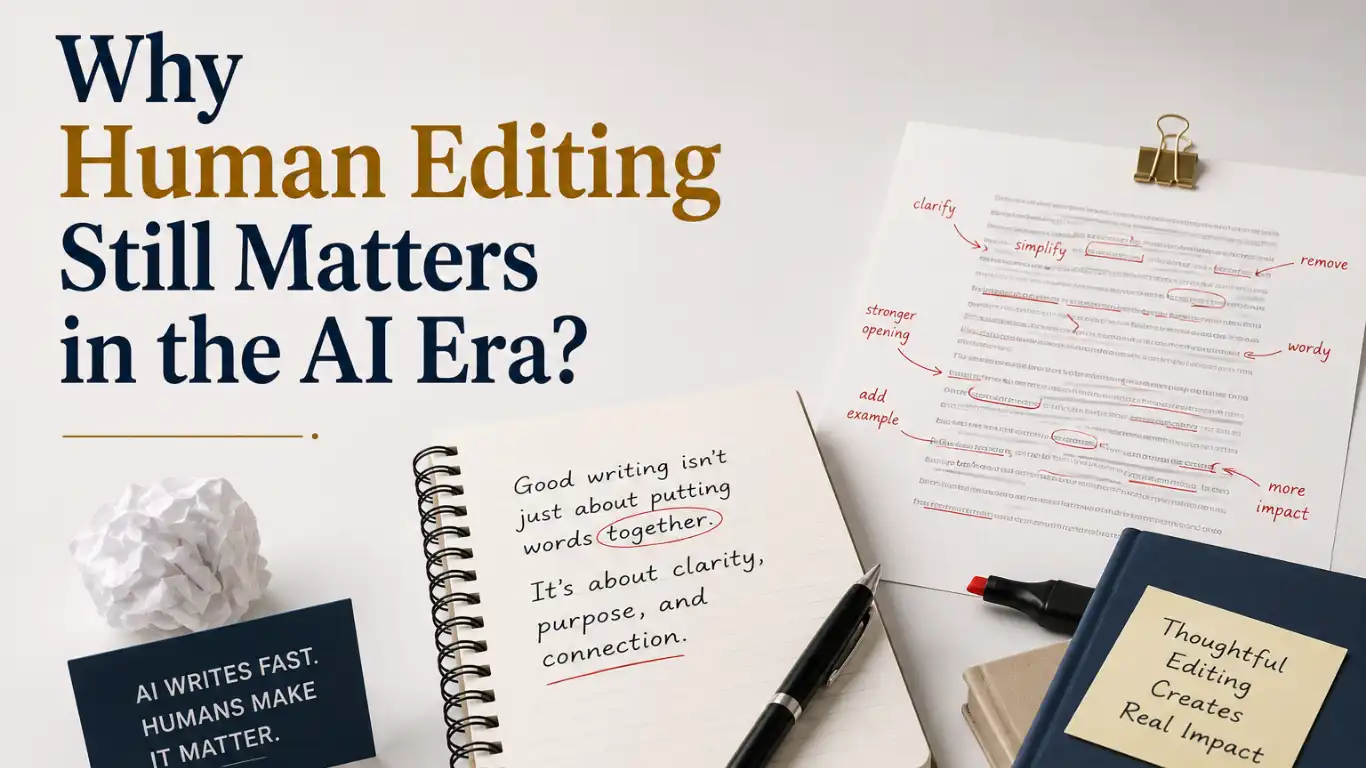
There are many different ways that AI can be used, and many ways that it cannot be. It still fails in many ways when it comes to editing research papers, ensuring that complex and high-level science is presented clearly and accurately.
AI cannot replicate the knowledge, judgment, and understanding of a subject that a professional human editor has. This is why editing services become critical in the scholarly communication process. In this blog, we will examine the 8 primary reasons why many researchers choose to use human editors rather than AI editors.
Reasons Why Human Editing Still Matters
AI can perform grammar and style editing, but meaningful editing requires the human touch that involves context, creativity, and emotional intelligence. And these are 8 reasons:
1. Context
Quickly compiling information is one of the strengths of AI. But, to understand context, there needs to be a better understanding of a particular topic.
In fact, you can instruct AI to compose a report on the changes that occurred in a company recently. The output could be “The company will be cutting 20% of its staff.” This is a true but lifeless statement.
An editing expert, however, understands the emotion in the statement and would re-word the concept: “We are now cutting our staff so we will have a stronger future.” This is a more aware approach that AI sometimes lacks, between pertaining to the facts and being sensitive.
2. Cultural and regional adaptation
AI can perform translations and generate language, but sometimes it lacks cultural understanding and regional nuances.
For example, a UK translation may use the word “flat” for a house whereas the American equivalent might be “apartment.” A UK translation might use the term “holiday” and the American version “vacation,” and these terms if not used with the appropriate audience might be confusing or even upsetting.
In addition to linguistic differences, cultural differences are also important. AI could have difficulty with the idioms, metaphors, or culturally-specific expressions. For instance, the phrase: “break the ice.” It could be confusing or completely meaningless if not translated directly into the other language as there may be no equivalent phrase in the other language.
Professional editors know the language and culture very well and can find equivalents to language expressions with suitable nuances. They identify regional and cultural differences and bring a local flavor to the text, ensuring an excellent fit with the audience’s language and culture.
Data reveals that 76% of consumers globally expect to see content that is relevant to their culture, which is not always understood by AI.
3. Creativity
AI can provide you with a fast and effective starting point, but it can be the creative block. Can deliver a lot of information but struggles to get a handle on humour, storytelling, or voice.
The human editor can inject humor or a personal touch that makes AI-generated material into something relatable and enjoyable to read, which cannot be achieved by technology.
For instance, a description that uses general terms, such as “The beautiful beach has a lush landscape”. “Colourful seashells line the shore of Almyros beach in Crete, as soft sands meet the shimmering waters.” is more similar to a sentence that is open-ended and can be edited to include the personal experience of the editor, whereas an editor adding their personal experience to the sentence would do so.
4. Factual accuracy
While AI can be helpful for information collection, it is not always able to identify whether the information is accurate, outdated, or incorrect.
Suppose that AI is able to extract financial details from a report that’s five years old, when newer information is available. Then, writing an article on the current health problem, using the example of an earlier outbreak or an unrelated health problem. It is very difficult to know the sources from where AI gathers information.
An editor uses critical thinking, and verifies facts for accuracy and credibility, especially in fields that change quickly, like technology and health. It could turn out to be a total disaster and clearly hurt readers’ confidence if it is not correct, requiring human oversight is essential.
5. Tone of voice
When AI-generated content is inconsistent with the informal style of the audience, it can throw off the flow of the reading and negatively impact the corporate brand. This fluctuation results in an impression of a jumbled and unprofessional storyline that may erode trust and reliability.
For instance, a business case that starts with “We propose to improve efficiency ……” may conclude with “We believe this will be very successful.”
Human editors know how to build a consistent voice and adjust the tone to fit your brand voice throughout the content and develop a unified message.
6. Word choice, grammar and syntax
Content created with AI tends to be straightforward and adhere to basic grammar rules, but it may lack the fluidity and natural tone that skilled writers can achieve. For instance,
AI could generate something such as: The meeting took place at 3 p.m., and the meeting covered important topics.
It sounds right, but repetitive. This would be edited by a human to better flow and minimize repetition: “The meeting was held at 3 p.m. and discussed important topics.”
Another drawback of AI is that it often uses clichés, overused phrases, or terms like “maximise,” “delve,” “leverage,” or “elevate,” which can result in a lack of variation and creativity in content. “The report was good,” needs to be humanized to add specificity and depth, such as: “The report was thorough and insightful.”
7. Target audience
AI content is frequently not tailored to industries with specific audiences. An example of this could be a chatbot that is creating content for old investors yet providing explanations for new investors. This incongruity can cause the target audience to disaffirm and make the message sound out of touch.
On the contrary, the human editor would start searching to learn more about the audience’s expertise. An editor, for instance, for experienced investors, would also investigate the market reports, financial magazines, or even case studies, to understand the market trends and challenges faced by the audience. In addition, they could also develop a user persona that outlines the interests, demographics, and problems of these investors to make the content more precise and gentle.
8. Industry knowledge/expertise
Industry-specific LLMs have shown great potential in generating more accurate and specialized outputs but can be more expensive than the widely-used models like ChatGPT. These specific models are trained to more effectively process the complexity of a specific discipline, such as law, finance or medicine, etc.
But while free tools such as ChatGPT are useful, they remain somewhat generic and need further improvement to be effective in specific areas.
For instance, the legal terminology used in one jurisdiction might not be the same in another, and AI may generate a legal contract that has incorrect phrasing or lacks key legal terms. It is better to have a human editor, whose background is in the subject matter because he/she will be able to edit the writing to make sure it is accurate, understandable, and legally correct so that there is not a risk of misinterpretation.
AI will not be replacing the best human writers.
Despite the improvements in capabilities, AI editing tools will never be a perfect replacement for human editors and will always be a valuable but limited assistance. The art of editing takes human skill and expertise – the ability to understand the language, to curate stories, to love the process of shaping a written word to its most potent form. In editing, as with everything else, it’s a sacred contract between editor and author to bring readers to transcendent ideas and stories. And that can only be achieved with the power of the human mind.
Final Thoughts
AI cannot completely take the place of human editors. The editors are crucial in recreating and polishing a book/content. Editors and writers, though, should be willing to experiment with new technologies and how it can assist them. AI is a tool meant to assist, not replace. Don’t think of it as a threat, think of it as both AI and Human editing working together to streamline and improve the editing and publishing process for Editors and authors.
FAQs
Q1. Why is human editing important if AI can write content?
Though AI can create content in record time, it can sometimes fall short in terms of context, emotional resonance, and accuracy. Human editors will enhance the content, fact-check it, edit it for readability, and make sure it meets audience expectations.
Q2. Will AI replace human editors?
No. AI can help draft and research, but cannot fully replicate human editors’ critical thinking, creativity, judgment and contextual understanding.
Q3. Can human editing boost SEO results?
Yes. Human editors can fine-tune content structure, tweak user intent, incorporate valuable insights, and enhance readability, resulting in improved search engine results.
Q4. What are the major drawbacks of AI-generated content?
Typical flaws are repetitive wording, factual errors, plagiarism, poor emotional appeal, and poor understanding of the context or the needs of the audience.
Q5. Can the human-edited content from AI be more credible?
Generally, yes. By having human oversight, errors can be detected, information can be checked, and content can be ensured to be of quality for the reader.