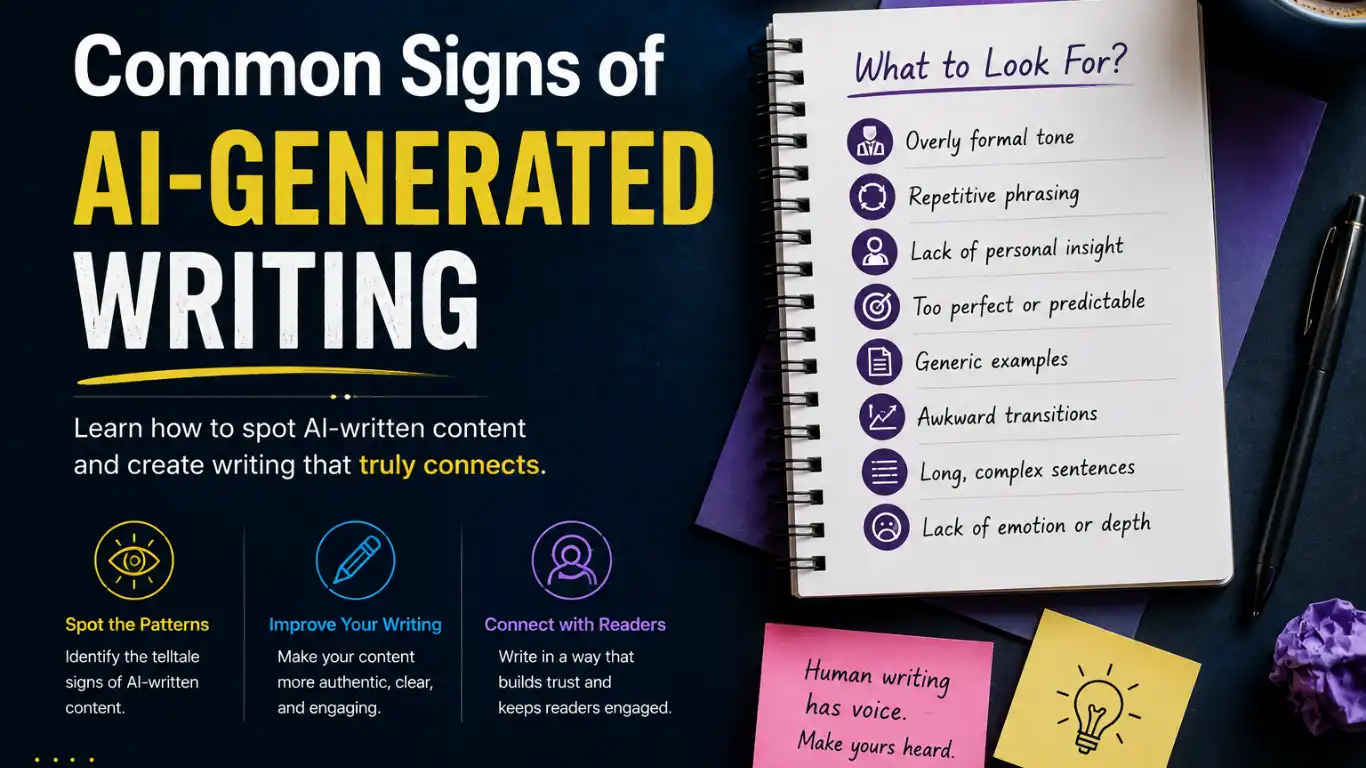
AI content generators, such as ChatGPT, have gotten more advanced. They create grammatical and coherent text, as well as informative, however, AI-generated content can have patterns that humans can notice.
Understanding these patterns can help you identify human-generated text from AI-generated content. The following blog will discuss common signs of AI-generated writing.
Human vs. AI Writing: Key Differences
It’s helpful to understand what sets human writing apart in order to identify AI-generated writing.
Human writing often has an emotional or personal connection to the writer. It may tell a story, say something funny, or say an opinion based on personal experience. It may also be riddled with mistakes, typos, peculiar terms or style of writing, or a lack of uniformity from one part to another, which reflect the eccentricities of a single writer’s voice.
Unlike a human-written article, however, an AI-generated one typically appears with a cold and even style, devoid of grammatical mistakes or strange sentence structures. It is very good at structure, but sometimes has less personality or spontaneity than human writing.
AI has a habit of taking a broad approach even if it’s trying to be specific. Can express emotion or conviction but may sound like a summary, not an original thought.
General Indicators of AI-generated content
1. Too Many Horizontal lines (— or -)
AI may be very fond of using em dashes (—), hyphens or HTML horizontal line tags (<hr>) to mark the ends of thoughts, particularly when they’re not flowing as they do in a natural human way.
2. Formal Connective Words (Moreover, Furthermore, However)
Avoid using “formal” transitions – “moreover,” “furthermore,” “however” – as these often make the text appear overly structured; instead, pay attention to what your audience cares about and get to the point.
3. Overuse of “Enhance”
The term “enhance” occurs significantly more times in AI-generated content. People use different synonyms to improve, boost, elevate or strengthen. When you’re concerned about word salad, think about what Google cares about.
4. Perfect Sentence Length
AI creates sentences that are uniform, steady and balanced. While human writers will naturally vary the length of their sentences, they will have both short and punchy sentences, and longer, more complex sentences.
The words “which mean” basically indicate that the articles you see have very evenly written paragraphs, which means it is most likely AI-written.
Pay attention to the uniformity of all the other paragraphs in the length of the words. This is a very even cadence which is characteristic of the output of a large-language-model. In a human text, the writers tend to blend short, concise sentences with more extended ones, depending on the situation and the purpose, in order to build natural rhythm and emphasis. If a paragraph consists of sentences of similar length, that is a big red flag that it was AI-generated.
5. Neutral, Objective Tone
AI writing often lacks emotional or subjective expression, whereas human writing may express them naturally in certain situations.
Although this is a personal achievement, the language remains clinical rather than excited or relieved (“decibel level,” “functioned within expected parameters”). The tone of the writing is also very neutral, typical of a report or factual article, which in turn is a sign that it was written by AI and not by a human.
6. Lack of Personal Anecdotes/Experiences
Unlike human-written content, which may contain anecdotes or experiential references, AI-generated content is not as likely to do so.
The sentence says it is providing examples but illustrates only general, all-encompassing features such as “flexible schedules,” “wellness programs” and “professional growth.”
7. Generic Examples and Lack of Specificity
AI may give a general description or a very broad concept, which may not be as specific as what a human might say in a detailed context or as specialized as specializing in a particular area.
Phrasing with catch-all words: examples of meaningful improvements, multiple sectors, best-practice, modern tools, positive outcomes, holistic, without names, dates, metrics or links, classic generic AI phrasing.
9. Key Terms Repeated
AI-driven content sometimes uses certain words or phrases too many times, which may seem repetitive and exceed the relevance of the text and topic or keyword. This is particularly true when the content being briefed to AI is being done so by a performance marketer / SEO.
An unnatural keyword echo (sustainability ×5) is a sign of AI writing based on an SEO brief instead of for people, and the repetition upsets the flow and sounds machine-optimized.
10. Absence of subtlety in humour and/or irony
AI-generated content typically does not feature subtle humor, irony, or sly sarcasm, which are often part of genuine human writing. So, for now, AI isn’t getting ready to embrace these details unless they’re asked.
Final Thoughts – Signs of AI-Generated Writing
AI writing tools are incredibly powerful, easy-to-use, and are rapidly evolving. They have a lot of merits, ranging from the brainstorming process to summarizing lengthy information. Yet, there are also new issues to deal with in regard to the recognition of someone or something that’s behind the content.
Though it’s becoming more difficult to tell an AI-generated text apart from a human-written one, it’s about what you observe, context and critical reading. When there are style inconsistencies, a lack of insight, or a mechanical tone, it is probably safe to assume that the writing was done by a computer. The tools and software support but do not supplant. Human intuition, curiosity and a modicum of scepticism are the best protection.
As AI becomes more prominent in communication, to hear it and understand when and how it can’t match human interaction.
FAQs – Signs of AI-Generated Writing
Q1. How to recognize AI-generated content?
Many AI-generated content pieces sound somewhat impersonal and mechanical. It might repeat itself, be too formal, or not have strong points of view or personal experiences. Some writing is easy and yet has an “empty” feel to it.
Q2. Is AI writing always devoid of human touch?
Not anymore. AI tools might sound quite natural these days. In some cases, AI-generated articles cannot be clearly identified, as some appear to be authentic. Nevertheless, there are many who can see that the writing lacks personality, humor, story and life.
Q3. Why does AI content tend to sound repetitive at times?
The AI learns from patterns. Usually restates sentence patterns and/or transitional words; sometimes it restates ideas, as it anticipates what is next in a text. We naturally have more variation in tone and phrasing than humans.
Q4. Is AI detection effective?
Not completely. AI detection tools have a tendency to make a few educated guesses and sometimes get it wrong. AI can flag human content and sometimes human content can be considered AI.
Q5. Can Google rank AI-written content?
Yes. Google primarily focuses on if the content is helpful, accurate and useful to the reader. With a little editing and helpfulness, AI written content can rank well.
Q6. What do human papers look like when they’re written by AI?
The typical contents of human writing involve personal experiences, opinions, storytelling, emotion, personality, and humor. Very quirky bits and pieces of your content may be the things that make it so authentic.