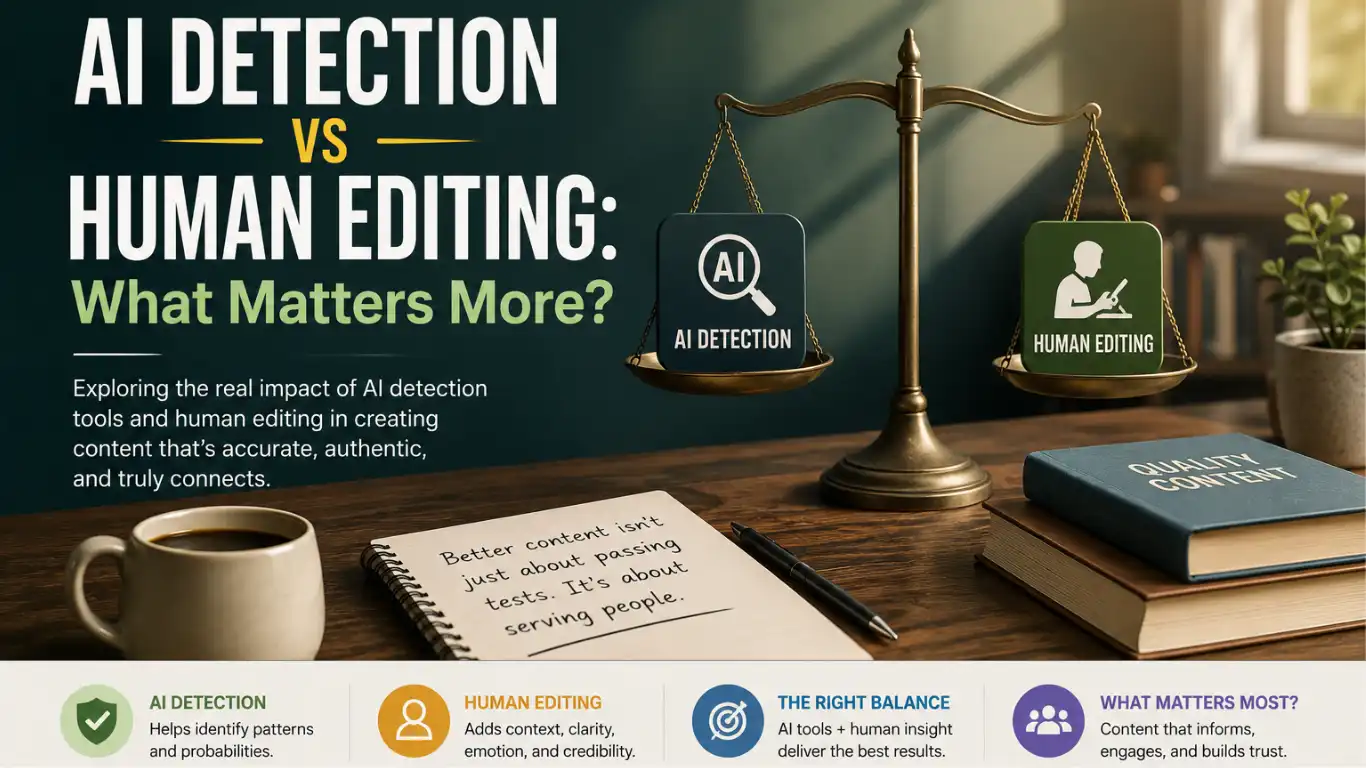
While the great power of AI is that it can create content quickly, creating text is just a part of the job. The true challenge is to make content engaging, accurate and actually useful to their audience. The use of AI detection tools has gained popularity as a tool to determine if writing is done by a machine and cannot improve the quality of the writing itself. However, human editing adds authenticity to the text that readers appreciate and strengthens readability, clarifies ideas, and corrects errors. The AI vs. human editing debate has gone beyond identifying AI; it’s about what makes content worth reading.
In the following blog, we are going to discuss what matters more: AI Detection vs Human Editing.
What is AI Detection?
AI detection tools use a pattern-matching algorithm to determine the likelihood that a piece of content was written by AI. They consider factors like sentence predictability, repetition, vocabulary and language structure. Popular tools such as Turnitin, Originality.ai, GPTZero and Copyleaks give a probability score instead of absolute proof.
The major drawback is that these tools are not the most accurate. Content written by humans may sometimes be identified as AI-generated, and content written by AI can be edited well and passed as being written by a human. This ambiguity should be interpreted as a “hint” rather than a definite verdict.
What is Human Editing?
Human editing is not limited to simply cutting down an AI score. A good editor enhances the quality of the content, adds clarity, context, logical flow and originality to the content. They make ideas flow smoothly, facts correct, and writing sound and authoritative.
Human editors will also tailor content to an audience. They bring in nuance, eliminate awkward phrases, enhance transitions, and contribute original insights that are beyond the scope of AI. The enhancements create more compelling and reliable content, irrespective of the detector’s label.
AI detection shouldn’t be the primary objective.
There are many writers who dedicate too much time in order to get the ideal AI detection score. In practice, this method can result in needless rewriting which can make content less readable.
Different AI detection algorithms can give varying scores to the same article. The pursuit of a percentage, so to speak, can be a never-ending cycle of little value. AI detection scores are not shown to readers; they evaluate the content based on its usefulness, accuracy and engaging nature.
Passing detectors could also be the motivation for making artificial changes that would decrease the quality of writing rather than improving it.
Why is editing still important for humans?
Human editing creates value since it makes the actual reading experience better. Optimizes for people, not software.
Well-edited content offers:
- The overall readability and flow are improved.
- Clearer explanations
- Stronger logical structure
- Improved factual accuracy
- More natural language
- Greater audience engagement
- Higher credibility and trust
These characteristics promote the success of content as it travels the web on search engines, in learning environments, in professional journals, and in business websites.
What is the SEO Perspective regarding AI Detection and Human Editing?
The search engines these days are giving more and more credit to content that has expertise, experience, authority, and trust. Search engines are not only targeting AI-generated content, but they’re also targeting pages that are actually serving users’ intent.
With human editing, businesses reduce duplicate content, enrich the topics with value, improve readability, and ensure accurate and up-to-date information, improving SEO. The low AI detection score is not as important to search performance as these improvements.
What is the importance of AI Detection?
While overall, human editing takes precedence, AI detection has its own merits.
The detection tool may be incorporated into an educational institution’s academic integrity process. They can be used in editorial reviews by publishers. AI testing can be used at the end of the process to assess content outsourced to businesses before it is published.
In such cases, AI detection is used as a screening method and not the ultimate decision maker. The material is still subject to human review prior to critical decisions.
How to Use AI Detection and Human Editing Combined?
The leading content creators aren’t afraid of AI detection and human editing; they use them in a sensible manner.
The workflow could be as follows, in practice:
- If suitable, create a draft with AI.
- Confirm information and update out-of-date information.
- Rewrite repetitive and generic parts of paragraphs.
- Include your own experience, examples or original thoughts.
- Human editing for improved readability, tone, and structure.
- You can also run a check with an AI to find parts that could benefit from additional edits.
The AI detection process feeds in feedback, and the human editing process provides real improvement.
How to avoid Common Writing Errors?
A frequent mistake is trying to drop the AI score without adding to the value. The other one is that if a piece passes the AI detector, then the content is of high quality.
There are also writers who don’t even look at facts or provide their own thoughts, but use AI exclusively. Others rewrite each sentence even if the original is already written in a natural way. The best way is to do balanced editing which puts the reader before software metrics.
Final Thoughts
If you’re wondering, “AI Detection vs Human Editing: What Matters More?”, the answer is human editing.
While AI detection tools can offer valuable clues, they can’t perfectly gauge creativity, expertise, connection to the audience, or original insight. Average artificial intelligence content becomes informative, engaging, and credible with a few tweaks by human editing.
Do not try to get an ideal AI detection rate—the point is to provide content that benefits readers. These are benefits that no detection score can match – a high-quality edit makes the content easier to read, more trustworthy and helps with SEO, and also results in long-term benefits.
FAQs
Q1. Is human editing more effective than AI detection?
Yes. By human editing, the clarity, accuracy, originality, and readability of the content will be improved, which will make the content more valuable to readers. AI detection tools are only able to guess the acceptance of text being AI-generated and are not able to evaluate the quality of content.
Q2. Are there tools which can accurately detect AI-generated content?
Not always. AI detection tools offer a probability-based result and have the potential for false-positive and false-negative results. While human-written content can be marked as AI-generated, well-edited AI content can sometimes be undetected.
Q3. Does Google penalize AI generated content?
Google is not penalizing content created by AI. Rather, it will reward valuable, assistive and trustworthy information that meets users’ desires. However, the most important thing is that the content is produced by either AI or humans.
Q4. Why do you have to make edits to AI-generated content before you publish?
Words can be edited out if they are used more than once, factually incorrect or inappropriate in tone and can help to strengthen the structure and add original insights. This adds a level of interest, believability and usefulness to your target audience.