AI writing tools can save hours of work! They will assist you in brainstorming, structuring the content using outlines, and developing a full draft in mere minutes. From creating blog posts and emails to writing website content and social media posts, AI can significantly reduce the time spent on writing.
But there’s one problem.
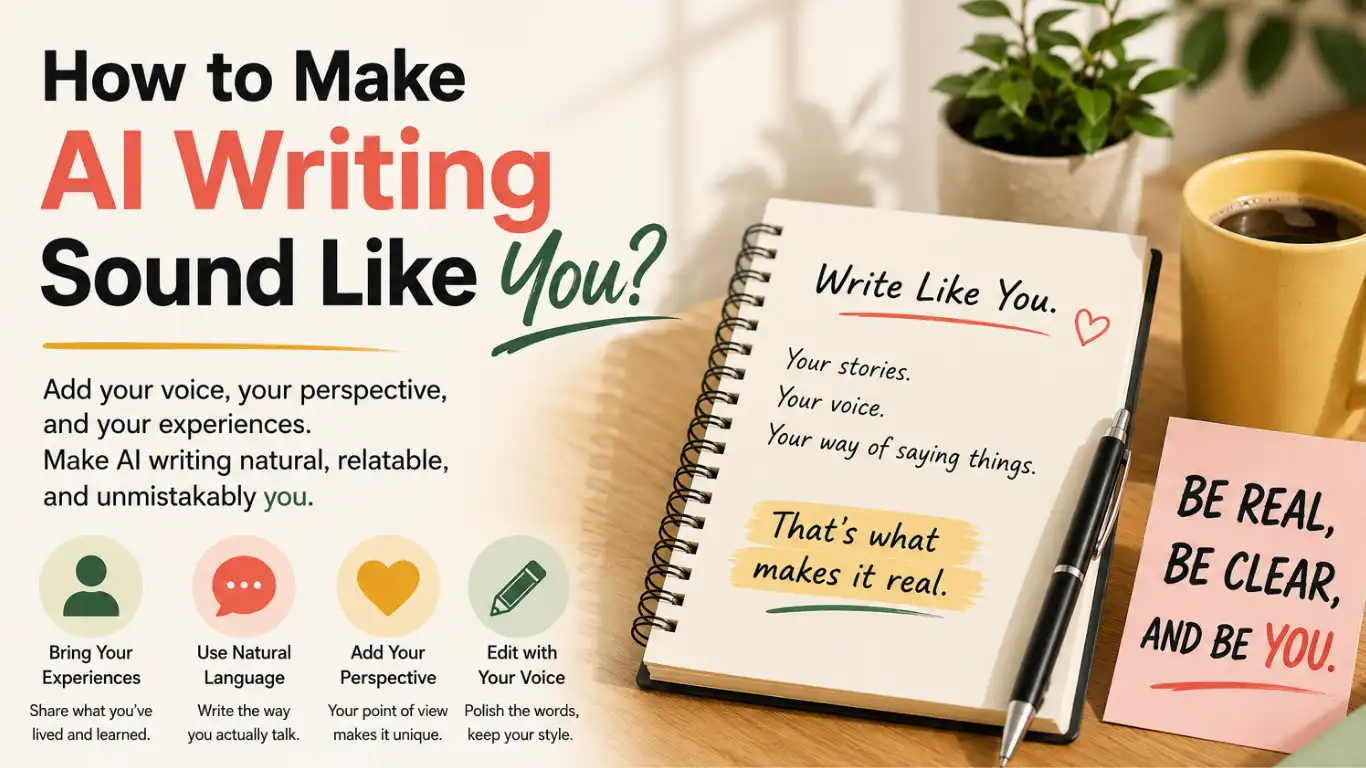
The vast majority of AI’s outputs cannot sound like the user. Rather, it is often bland or clichéd or overly slick. Information may be correct, but there is no personality and individuality. This blog will discuss everything you need to know about how to make AI writing sound like you.
Why is AI writing not personal?
The purpose of AI is to make the language it produces clear and grammatically correct. It is capable of forecasting the most likely sequence of words based on your stimulus and what it has learned during training.
That can make for readable content, but not personal and individual.
What you write reflects your experiences, opinions, words and manner of thinking, your sense of humor, and your way of explaining ideas. Unless you’ve fed it these things, AI has no way of knowing them.
This means that a lot of articles created by AI tend to be of the same style. Uses familiar introductions, safe explanations and predictable conclusions. Content is informative, but not memorable.
That’s the importance of editing. It’s not only to correct grammar. This is to replace the generic writing with likeable language.
What is special about your writing style?
Before you can make AI sound like you, it’s important to understand what makes your writing different from someone else’s.
All authors have patterns that they form over time. Some like to write short sentences and others like to tell stories before introducing the main point. Some are formal and others are informal and conversational.
The words you select also affect your writing style. Simple language, rhetorical questions, and explaining difficult ideas in terms of examples are allowed, but may be done periodically. Look at these little steps, and you’ll see how they build a voice that readers will start to identify.
This consistency is used by professional writers, as it establishes trust. If readers like your writing style, they will come back for more.
Tips to make AI writing sound like you
You should not attempt to copy someone else’s voice, but work on developing and building up your own style. The following tips will help you make AI writing sound natural in your own voice.
1. Developing a style of writing that is truly yours.
If you don’t understand what makes your writing different, you can’t sound different.
Think about how you interact with a friend and/or a client. Maybe you would prefer to use common words instead of technical terms. You might like to use examples to clarify more abstract concepts. Some use a friendly or even a conversational tone, while others are more professional in their writing.
These are the little habits that contribute to your writing voice. Having a style after creating it will make it much easier to tweak AI-generated content to make it feel natural.
2. Take out Words You Would Never Say
One of the simplest means to humanize AI writing is to substitute terms that are not typical or natural for the human writer.
Phrases that tend to be associated with AI often include delve into, it is important to note, or in today’s rapidly changing world. These expressions are correct, but so common that readers can easily identify them.
Do use simple language; use plain words. Use the same language in your writing as you do in your speech. Don’t say a sentence in conversation, rewrite until it feels comfortable.
Simple writing is not downscaling. Actually, it’s often more easily understood and much more fun to read.
3. Include your own ideas and experiences
This is what will make your content unique.
While AI can provide explanations about a topic, it cannot provide your experiences or opinions. Discuss in your article what you have learned from a tool, project or error you made by trial and error.
Just a few observations of your own can make your content shine. Readers like to read practical tips from a person who has tackled the situation, rather than merely described it.
Don’t pretend to know the answers, just do what you can to be helpful. That’s what readers remember.
4. Read Your Content aloud.
Some of the easiest editing tips are to read your article out loud.
When you read your content aloud, there are more chances that you will pick out awkward words and sentences, instead of just reading them on a screen. You will get to know areas in which you might see formality, robotic tone, repetition and confusion in the writing.
If the sentences are not easy to read, your readers will also not find them readable. You need to rewrite them in a more natural way. This is a small but important habit to incorporate into your content.
5. Include Examples Wherever Possible!
Examples will give a reader a much better understanding of your point than extended explanations. When providing advice, demonstrate in a real circumstance. Doing it even for the simplest of reasons makes your writing more useful and more human.
6. Avoid using long sentences or complex sentence structures.
Avoid using long sentences as they can be hard to follow. AI may sometimes attempt to cram too much information into a single sentence, resulting in the material being too dense. Avoid using long sentences to the extent possible. Clear writing is readable and enhances your message.
In Conclusion
AI is a great tool for making your writing more refined, but it should not replicate your own voice. The key to writing the best content is to bring together AI and your own writing skills. You can enhance AI-generated content by incorporating your own writing style, simplifying vocabulary, and removing repetitive phrases and words.
You must keep in mind that readers do not connect with robotic voices; they resonate with real-time content. Save time with AI, but make it your own voice. This is what makes your content memorable, reliable and readable.
FAQs
Q1. Is AI writing genuinely the same tone as my writing?
Yes, but it takes some editing. While AI can generate a solid initial draft, a human editor can infuse it with their own voice, perspectives, and insights. The more personal the writing, the more natural it will be.
Q2. How can you humanize AI content?
Begin by eliminating robotic expressions, cutting out long sentences, and informal words with simple ones. Finally, include actual examples or one’s individual experiences to make it more real.
Q3. Do I need to just retype the entire AI-generated article?
Not necessarily. If the structure and information is good, it only requires editing parts that sound unnatural or repetitive. Pay attention to improving flow, adding your voice, and making content more engaging.
Q4. What makes AI writing so repetitive?
AI generates text by predicting language patterns, which may result in the same information being repeated or similar sentence structures within the article. These repetitions can be eliminated by careful editing and make reading easier.
Q5. Does humanizing AI writing enhance SEO?
Yes. It provides a better user experience and encourages longer page views. The search engines are now increasingly giving credit to original content and content that offers some true value.