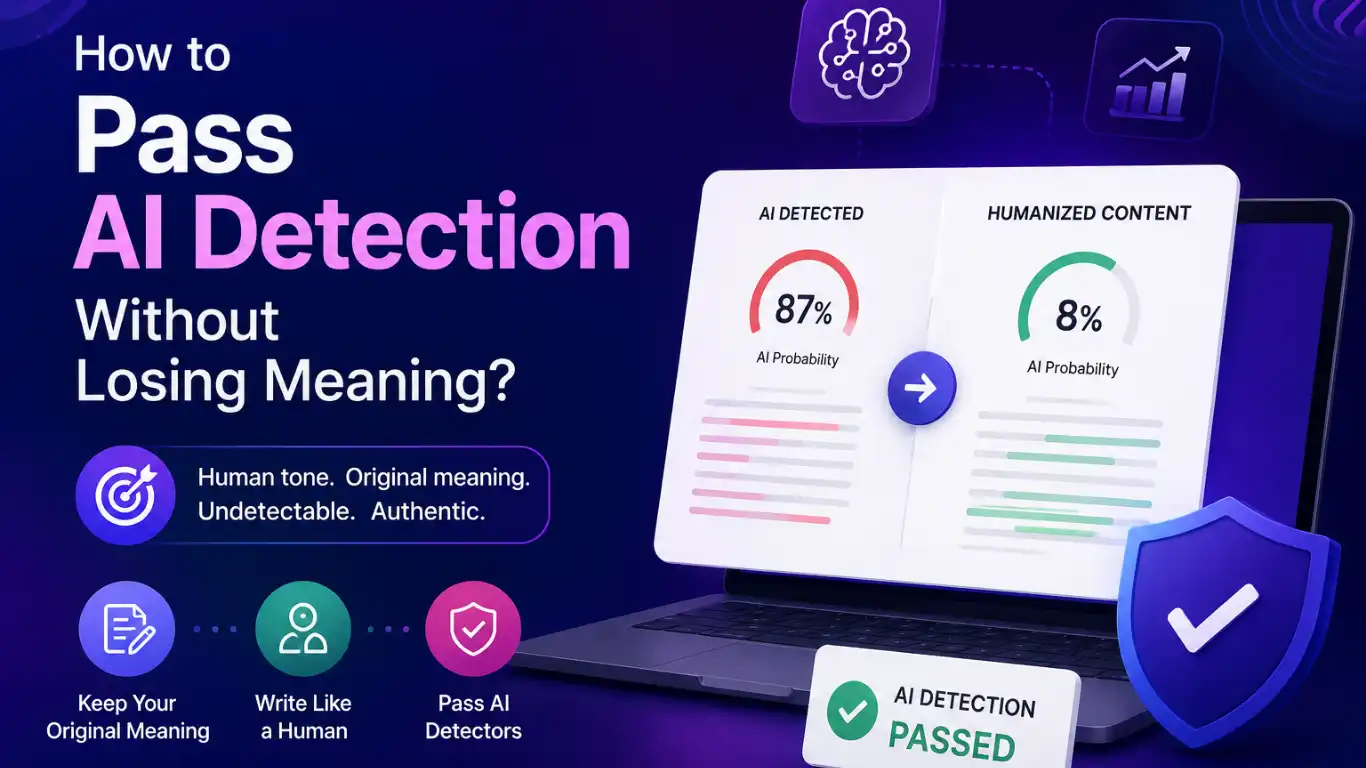
The problem with AI detection is that it’s tightened up rapidly in 2026, and if you write and publish or submit content frequently, you’ll feel it. No longer will tools such as GPTZero, Turnitin, and Originality.ai use simple keyword patterns. They examine sentence rhythm, the predictability of sentences and the development of ideas within paragraphs. Moderately edited AI text is now flagged even when its structure remains unchanged.
This change is particularly relevant in the context of chatbots becoming more prevalent, making it increasingly important to understand how to make your text undetectable by AI. It isn’t about replacing a couple of words or running text through the basic paraphrasing tool. Detectors are looking at consistency, something that humans rarely have, such as sentences of similar length, overly clean grammar, repeated transitions, etc. Once they accumulate, the content is flagged for some reason or other.
Nowadays, the best way to get detected is not only to have a bad grade, but also to have a non-approved book, not be found in search engines, and to lose clients’ confidence.
The following tips help you to change the structure, tone and depth of the text to such a degree that even today’s AI text detectors won’t classify it as AI-generated, but rather based on how they are marketed.
How Does AI Detection Work?
The key to avoiding AI detection is to know how it works.
AI detection tools are designed to identify patterns and structures, especially common ones, in large amounts of AI and human writing samples. They measure text perplexity (how predictable the text is) and text burstiness (how many short and long sentences are used) to determine whether a text was written by a large language model or a human. More sophisticated AI scanners also search for more linguistic features like tone, text structure, repetitions, rhythm, etc.
AI detection systems have complex algorithms. This is why paraphrasing alone isn’t enough to make AI-generated content unreadable. Needs changes in style.
So, how do search engines catch AI writing? They try to find the following flags of AI-generated content in your writing:
- Variation in style of writing.
- Overuse of bullet points.
- Excessive repetitions.
- Untrue or fabricated facts, statistics and quotes.
- Outdated information.
- Unusual sentence structure, with robotic sentences.
How to Make Artificial Writing Sound Human?
The quick answer to avoiding AI detection is to ensure that your text is natural and easy to read. The primary methods for making AI text sound more like human writing involve incorporating a human element, adjusting sentence structure, ensuring the writing is in the active voice, and verifying all the facts.
Now, let’s get into more detail and discuss some of these techniques:
- To add a human touch: Avoid using AI-generated drafts without human editing. Integrate personal thoughts, opinions, and illustrations. In addition, give emotional meaning to relate to the reader. These techniques give the impression that the writing is real. AI cannot provide input that is original or creative, unlike human writers.
- To alter sentence structure: Human-generated content doesn’t stay the same. It has a dynamic sentence structure and construction, while a text of AI origin will often have repetitive patterns. Converts AI-generated content into human-like text using a blend of short and long sentences.
- By using the active voice: The study of language models found that using the passive voice is a method used by humans to produce unique writing styles, to avoid constraints, and to highlight key points in a text in a 2025 study. Passive voice, on the other hand, is passively used by AI-assisted text, and therefore more often. To avoid AI detection, it is essential to identify these patterns in text drafts and reduce their frequency.
- To verify all facts: AI can be based on irrelevant, fabricated, or outdated information. All facts, quotes and statistics in your drafts must be validated to produce human-like text.
How to Pass AI Detection Without Losing Your Meaning?
In an age where AI detection tools are becoming more common, the myth has spread that once you’ve gotten past AI detection, you’ve lost the original voice and meaning of your content. But that’s not entirely accurate. Let’s take a look at this issue from two angles.
i. If your content is actually AI-generated.
There is a high likelihood that your content won’t pass through AI detection even when using an undetectable AI writer. Most of the time, human intervention will be required. In this instance, there is no loss of voice due to editing. Rather, it will help you build your own writing style and engage the reader.
ii. If it is human-written and mistakenly identified as AI.
Unfortunately, AI content detectors aren’t perfect. They are not yet accurate and can mistakenly identify human-generated content as AI content. In this instance, editing to evade AI detectors can be particularly frustrating.
Mistakes to Avoid When Trying to Bypass AI Detection
Following are some mistakes you need to avoid while editing your AI-generated content:
i. Using vague prompts.
Without customizing and personalizing your prompts, you don’t stand much chance of creating undetectable AI-generated texts.
ii. Skipping manual editing.
The desire to save time and submit work that has been generated by an AI can be quite strong. But even if you select an AI tool that isn’t detectable, it is possible for at least some of its components to be flagged by an AI detector.
iii. Lack of originality and detail.
AI-generated content is typically generic. It’s undetectable because of unique perspectives and thoughts.
iv. Not verifying the facts or giving sources.
If you’re creating content, there may be some inaccurate data or untrustworthy facts. It’s crucial to do fact-checking to maintain credibility.
v. Adding mistakes on purpose.
If you create the content, it will generally be error-free and typo-free. Many students take advantage of this and deliberately add errors to trick checkers. You may be able to avoid AI detection by using this. It will also take a toll on your writing skills, though.
The Bottom Line
Writers can have a lot of opportunities through AI. It can replace search engines for speedy searches, aid in brainstorming and make drafting easier. However, the issue is that most search engines can identify AI authorship with AI checkers, and this can lead to consequences.
In summary, it is not enough to just rephrase or make errors to evade AI detection. When editing, it’s important to do so comprehensively in order to achieve the best results. You must know the tips and tricks to get past AI detection without losing the meaning and intent of your writing.
FAQs
Q1. Is it possible to write without detection by AI?
There is no method that guarantees a clean result. AI detectors work on probability models, not proof. The aim is to minimise risk, rather than aim for a zero score.
Q2. Can paraphrasing “get around” AI detection?
No. Making changes to words, not structure. Predictable sentence flow is detected most of the time even when rewritten.
Q3. When does human-written content get identified as AI?
Statistically clean, neutral and highly structured writing may appear as if produced by AI. If there is no personal context, the number of false positives goes up.
Q4. Is there any need to use AI humanizer tools as the sole method to ensure my content is humanized?
No. Tools can be used for restructuring but need manual editing, particularly for introductions, transitions and examples.
Q5. Is vocabulary or structure more important?
Structure. Sentence rhythm, paragraph flow and reasoning depth affect detection more than word choice.