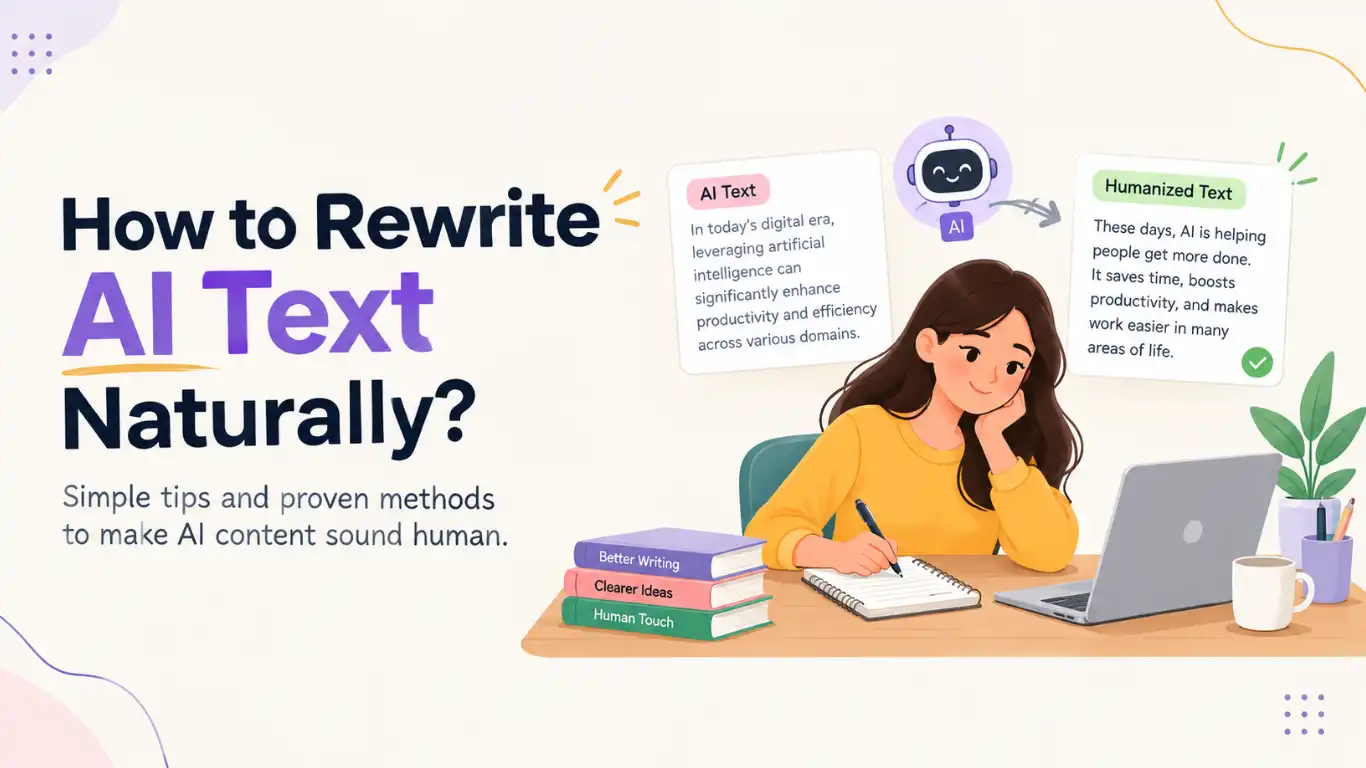
The best approach to rewriting AI text is to look for the core message or topic, and then repeat it in a different way. Read the AI draft, put it aside, and share the main idea out loud like talking to a colleague.
Record that natural explanation and set it as the new rock foundation. You alter the sentence structure and introduce your own practical examples, which removes the formulaic elements from the structure of your text. The following blog will discuss all the steps which can help you to rewrite AI text naturally.
What does Natural Rewriting really mean?
Natural rewriting is more than just getting a computer to use a simple vocabulary. It means making a document sound conversational, natural, personal, and coherent, as if it were written by a real person.
AI models tend to compose in a very formulaic and structured manner, most of the time using phrases such as “Furthermore” or “In conclusion. Repetitive markers are removed when performing a natural rewrite. Converts general language into specific, nuanced language that is rooted in human reasoning.
How to make it more than just synonym swapping?
A lot of writers attempt the way to humanize AI text by merely right-clicking on phrases and selecting synonyms. This generally translates into awkward constructions that don’t convey meaning and sound unnatural.
Moreover, AI writing detectors aren’t only searching for particular words. They look at the text features that can be easily explained, such as perplexity and burstiness and analyze the text for these patterns which cannot be corrected by replacing words with synonyms. If you want to improve a draft, you need to modify the structure of sentences.
Steps to Rewrite AI Text Naturally
- Determine the main idea.
You must first grasp the exact meaning of the AI before making any changes to the text. AI drafts tend to be somewhat context-rich and repetitive.
Read and underline the central argument or factual claim in the paragraph. After you have identified that one main point, you can safely remove any surrounding “filler” words.
- Rewrite the text in your own words and complete
Once you have isolated the core idea, restate the idea in your own sentence structure. If the AI sentence is long and complex, break it into two shorter sentences.
The logical order of the paragraph can be changed as well. If the AI moved the conclusion to the end, for instance, consider placing the main takeaway at the very beginning for a more impactful effect.
- Add Context, Evidence or Personal Reasoning
AI models have no personal experience and real-world context. To make the text sound human, you need to include details that the AI is unlikely to know.
Include a short anecdote, reference a specific case study or include your own professional opinion. This will make your writing more interesting, as well as make you an authority on your topic.
- Edit for Flow, Tone and Clarity
The last step is polishing the draft to make it smooth. Read your rewritten text aloud to look for any awkwardness in the words or robotic delivery.
Take note of your sentences and use a variety of short, punchy sentences and longer, descriptive sentences. Eliminate any traces of Artificial Intelligence (AI) jargon like “delve into” or “a testament to” and use straightforward and direct speech.
Checklist to rewrite text naturally
When you’re thinking about a rewritten draft as “done,” ask yourself if the new version meets a basic editorial requirement:
- The first sentence is concrete, rather than filler.
- It doesn’t matter if it is your logic that is in the paragraph order; it’s not the default order of the AI.
- One or more sentences contain a particular example, restriction, source, or observation.
- Multiple transitions have been deleted or modified for smoother transitions.
- The final wording remains the same as the original draft, which does not include any facts or citations.
- This checklist will be very helpful if you’re rewriting in a hurry. It encourages you to concentrate on meaning and accuracy rather than on the detector and endless swapping of words.
Final Words
The key to natural rewriting of AI text is taking ownership of it. A standard vocabulary won’t cure the common lack of pace and style in machine-produced copy.
Rather, use AI-generated content as a starting point. You can strip away the verbosity, restructure sentences, and add your own concrete context to make robotic text into clear, engaging and real human communication.
FAQs
Q1. How to naturally rewrite AI text?
It’s best to use the main content of the AI draft and reword it entirely. Vary the sentence structure, sentence length and add your own particular examples to make it authentic.
Q2. Is it possible to avoid being detected as AI writing by paraphrasing or humanizing text?
While paraphrasing may alter the expected patterns (that detectors are looking for), it does not guarantee results. The tools that detect the changes are constantly being updated, and never overlook humanizing software as a dependable bypass method.
Q3. Is there any chance for an AI detector to get it wrong?
Unfortunately, there are cases of false positives that come with AI detection tools. They have a tendency to believe highly-formatted human writing might be AI-generated, so should not be treated as definitive.
Q4. How to revise AI-like writing in a safer manner?
The best way to do this is by original thinking, clear evidence and manual check. Outline using AI but write the final draft with personal understanding and proper citations.
Q5. What can Humanify do to improve AI text?
With Humanify rewriting modes, you can find a more natural way to phrase things when you feel you’re stuck. It can make your text humanize and make it look like a completely human-written text.