It’s the modern era and technology has advanced significantly. That makes our daily-life tasks so much easier, particularly creating content, isn’t it? Yes! It’s about the innovative AI tools. They’ve really made it easy for bloggers and writers. With so many robot in the mix, it’s an important thing to humanize it.
The success of SEO in 2026 will rely on the original, useful and natural content of the Google search engine. Generating human-like content is challenging for AI models, so it requires content with a creative, emotional, and human touch to connect with readers. This is the actual gem to improve SEO, rank with Google, capture the attention of your audience, and grow.
Content that’s humanized isn’t simply an option; it’s a must for a startup, author, or anyone seeking to boost business visibility and raise search engine rankings.
So, let’s delve into the specifics of what exactly the humanized content is and why it has become so crucial for businesses’ modern SEO.
What Do You Mean by Humanizing Content?
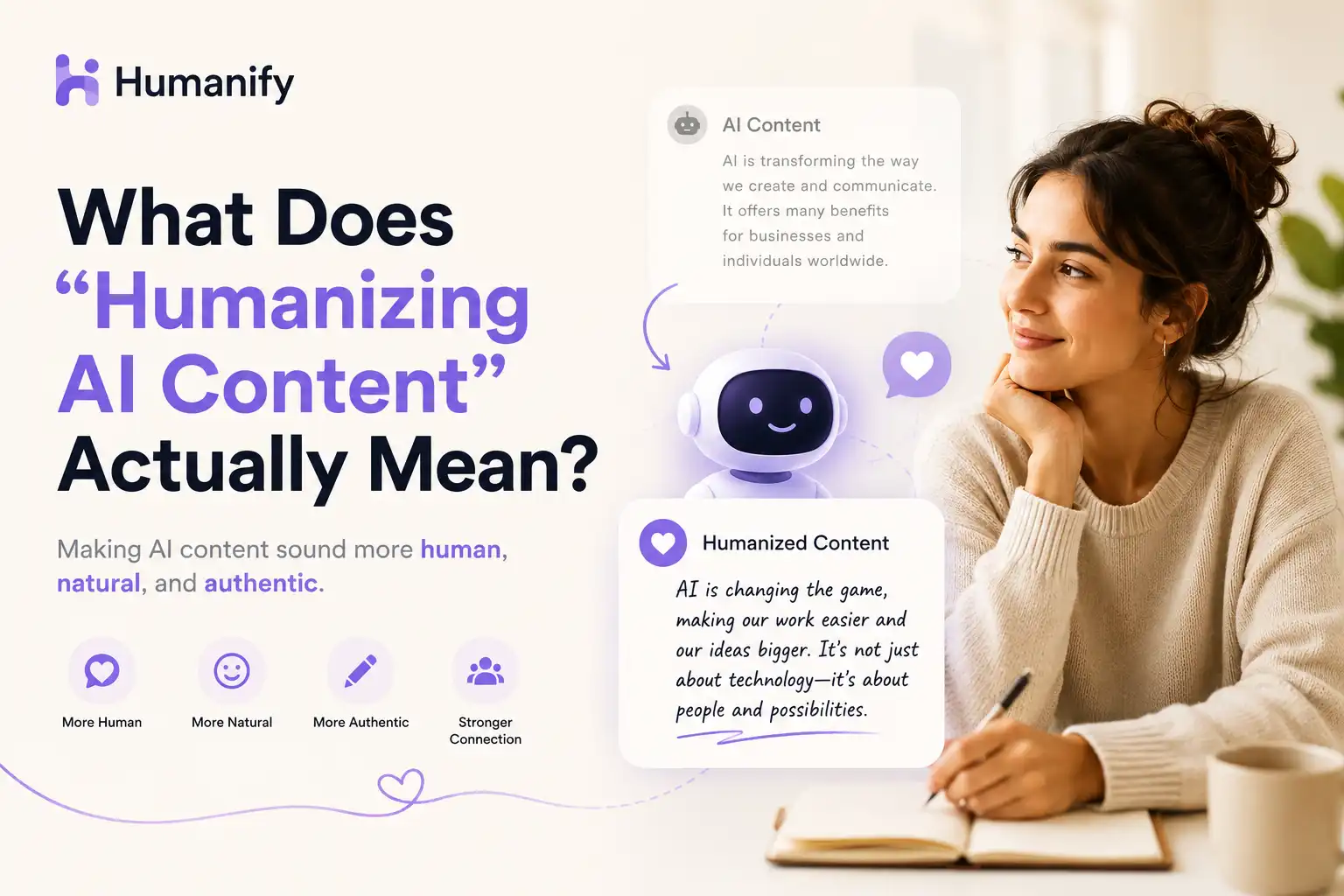
Humanizing AI content involves refining, editing, and enhancing the content produced by an AI to make it sound like a human. AI writing is so technical, formal, or to the point. This way, your content can never be interesting and ‘real to life’ to your readers since they believe it is being led by some machine.
This is what makes you lose your readers quickly. If you add some emotional appeal, natural human feelings, less jargon and stir up interest to top of your content with content that has instructions, you get more traffic.
Key Factors of Humanized Content
You might not always be able to tell when the content is humanized and can be used on platforms.
Hence, I’ve touched upon the following common features which show that the text is humanized, especially by the AI checker.
i. Uniform Flow of Sentences
If the information is created by an AI model, it can simply present the information. The consistency among sentences is obtained through human analysis.
ii. Simple and Easy to Understand Words
Humans don’t use complex or overly formal words. They use phrases that speak in everyday life–simple and easy to understand.
iii. Change Sentence Structure
If the writing has all the same length sentences, the reader is quickly alerted to it as AI. Authors do not pay attention to the length of the sentences.
iv. Natural Transitional Words
Logical Connections/Soft Transitions draw attention to the passage of one idea or intent to the next and create a smooth, unbroken flow of writing for readers. That is, they are only used when necessary. These kinds of adjustments and flow are only available in humanized content. There isn’t any natural discussion of them only when they need it when using artificial content.
Facts, information and updates are included in real human Emotions: AI writings. A human adds the feeling of any emotions to it, whoever it feels, without losing its professionalism. AI does not provide feeling and emotional insights within the content.
Why Content Humanization is Important for Modern SEO?
The primary goal of humanizing content is to produce useful content that people want to use, not for search engine algorithms.
It’s a basic fact of today’s search engine optimization: Search engines, particularly Google, have made it a point to explicitly reward content first that actually helps people solve their problems, that answers their questions comprehensively, and that demonstrates the actual expertise of the content authors.
1. Align with Google’s “Helpful Content” & E- E- A-T Priorities
Lots of content that is helpful, reliable and organized well is considered and ranks specifically, according to Google’s guidelines and recent algorithm updates. Content of this type typically is created under the (E-E-A-T) rule: Experience, Expertise, Authoritativeness and Trustworthiness.
The content that is found to be generic, keyword stuffed and contains exact data is devalued in comparison with content that is obviously created to meet a human need.
2. Prioritize User Engagement
Humanized content that is comprehensible, organized, and actually provides helpful guidance keeps readers engaged on the page longer, minimises pull-away rates and influences the right interactions, such as clicks to inner pages or social sharing.
The signs of quality are stabilized by these behavioral signals, and the search engines are able to interpret them. This helps to boost the organic rankings even more.
3. Establish Credibility and Trust
If you can provide accurate information, provide some personal touch, have information from experts, or have information that is explained, your target audience is more likely to trust and find your information credible.
Additionally, it guarantees long-term connections with those people. Business outcomes are possible when you win to give reliability and confidence on your part.
There are even more benefits to trusted content: it is shared, linked to, or mentioned by other sites. This way, not only do you begin to count on your company, but you’re also boosting your website’s authority over time.
4. Enhance Natural Keyword Integration & UX
Seo needs to get the keywords in useful explanations and not try to force them into text; humanization is the only way to do this. This makes it easier to read and lessens the chance of using outdated marketing strategies, such as ‘keyword stuffing’ which has a bad impact on rankings.
5. Scale Long-Term SEO Growth
The humanizing content is the power which provides long-term success of seo. Humanized content remains in excellent performance in the highly competitive market and caters to the needs of real readers, building trust. Make sure of multiple visits by the audience, more persuading and gradually escalating organic traffic.
Final Words – Humanized Content
To sum up, the content which does not sound machine-made or incomprehensible sounds much better than that from AI-exact instructions.
The key aspects of content that sound more humanized contain the natural flow of consistency among the sentences, accurate phrases, simpler terms, and varied sentence lengths.
You do not have to completely change the entire content, just make changes where you find the AI complex wording, same style sentences, weak relevancy, and lack of emotions.
FAQs – Humanized Content
Q1. What is humanized AI content?
Humanised AI content is AI-generated (or AI-rewritten) content that mimics human writing, using a range of tone, emotional flow, sentence structures and unpredictability. It’s designed to circumvent AI detection and connect with human users.
Q2. Is it possible for AI detectors to detect human-written content?
AI detectors examine text that is structured and clean/predictable. NetusAI identifies problem areas and restructures even in hybrid or polished drafts.
Q3. Does the paraphrasing of content make it unidentifiable?
Simple paraphrasers don’t work well and AI detectors can still catch them. NetusAI successfully humanizes content, changing its tone, pace and sentence structure.
Q4. Why is humanizing AI content important for SEO?
Google’s algorithms now prioritize content that has expertise (E-E-A-T). Too optimized or AI-generated content is detrimental to rankings and trust. NetusAI helps humanize SEO content, avoiding algorithmic penalties.
Q5. How to personalize AI text?
The most effective approach to improving AI-generated text to make it sound more human-like is to use a humanizer tool for refinement. Humanizer tool allows you to paste your draft and instantly tone adjust, flow enhance and phrase to improve your original message without any loss.
Read More : A Client Came to Us After AI Destroyed Their Affiliate Traffic — Here’s How We Fixed It